
Market data source
where the questions come from.
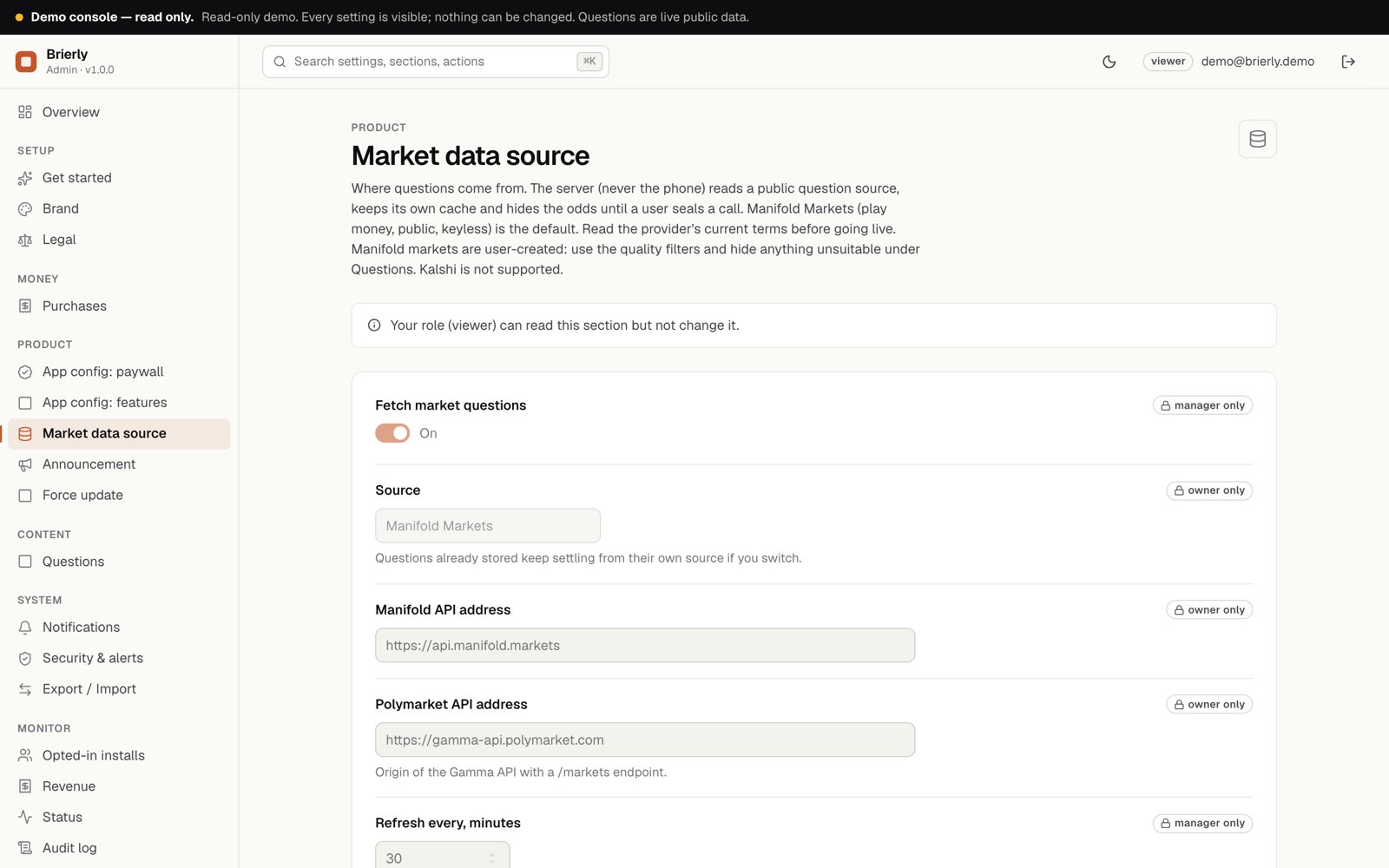
Brierly needs questions with a clear Yes or No result, and a crowd probability to compare the user with. Your server reads them from a public source, keeps its own cache, and hands out the crowd's odds only after a call is sealed. You choose the source and the filters in the console, and you are responsible for following the source's terms.
01The three choices
Console, Market data source, field Source (only an owner can change it):
| Source | What it gives you | Notes |
|---|---|---|
| Manifold Markets (default) | Binary (Yes/No) questions from the public Manifold Markets API. Play money, no API key. | Questions are written by the public, so the quality filters below matter. Your server needs outbound internet access to api.manifold.markets. While writing this guide (2026-11-17) the shipped server fetched and served open questions from it (verified from the writer's network). |
| Polymarket Gamma (optional second provider) | Binary markets from the Gamma API, with category and liquidity filters. | It only works where your server can reach polymarket.com. Some internet providers and some countries block it (the item's author reports that this applies in Slovakia; the writer of this guide did not test it). Test from your own host first, as shown below. Switching it on shows its own attribution line. |
| None (custom questions only) | No outside source. Only the questions you write yourself. | Nothing is fetched. The attribution line becomes "Questions curated by the operator." |
Kalshi is not supported: its developer agreement limits use of its data to a member's own trading and bans sharing data without written consent (contract/CONTRACT.md).
Before you go live, read the terms of use and API terms of the source you pick, as they are today. Terms change and differ by use. This guide does not give legal advice, and the source's licence is not part of this item. The author could not check live terms for this guide: unverified.
02Test the source from your host
Run this on the machine that will host the server (not on your laptop at home), because the server makes the request, not the phone.
Flutter runs natively on Windows: use PowerShell for the flutter commands and Android builds (iOS builds need a Mac). For the server, either install Node.js 22.12+ for Windows and use PowerShell (replace cp .env.example .env with Copy-Item .env.example .env; there is no openssl by default, so use WSL or any random 64-character hex string), or run the commands in WSL 2 (Ubuntu) or Docker. macOS and Linux users can ignore this note.
curl -s -o /dev/null -w "%{http_code}\n" "https://api.manifold.markets/v0/search-markets?filter=open&contractType=BINARY&limit=1"
# 200 means the default source is reachable.
curl -s -o /dev/null -w "%{http_code}\n" "https://gamma-api.polymarket.com/markets?limit=1"
# Only for the optional second provider. 200 means reachable; a timeout or error means blocked from this host.
On Windows PowerShell use curl.exe instead of curl. After you start the server, the Overview page of the console also has a check, "Market source reachable and filled".
03Quality filters (Manifold)
Because Manifold questions are written by anyone, the server only keeps those that pass your filters. The defaults come from server/src/admin/manifest.ts:
| Console field | Default | Meaning |
|---|---|---|
| Fetch market questions | on | Off stops fetching; stored questions stay. |
| Manifold: minimum unique bettors | 50 | Skips questions few people traded, because their odds say little. Range 0 to 100000. |
| Manifold: minimum volume (play money) | 500 | Skips thinly traded questions. |
| Manifold: only these topics | science, technology, economics, sports, culture | Comma separated topic names. Empty means any topic. |
| Manifold: never these words | a long default list | Comma separated whole words, checked in the question title and its description. The default list covers adult and violent words, finance tickers and similar topics. Read it in the console, then widen or tighten it for your audience. |
| Only questions closing within, days | 60 | The horizon. Short horizons give results sooner, so users see their scores sooner. Range 1 to 365. |
| Most open market questions | 100 | Range 5 to 500. |
| Refresh every, minutes | 30 | Range 5 to 1440. The Questions page also has a "refresh now" button. |
| Manifold API address | https://api.manifold.markets | Change only if the provider moves it. |
Polymarket only: categories allowed and denied (comma separated, empty = all), a minimum liquidity (default 1000) and the API address (default https://gamma-api.polymarket.com). The topic and word filters above apply to Manifold only.
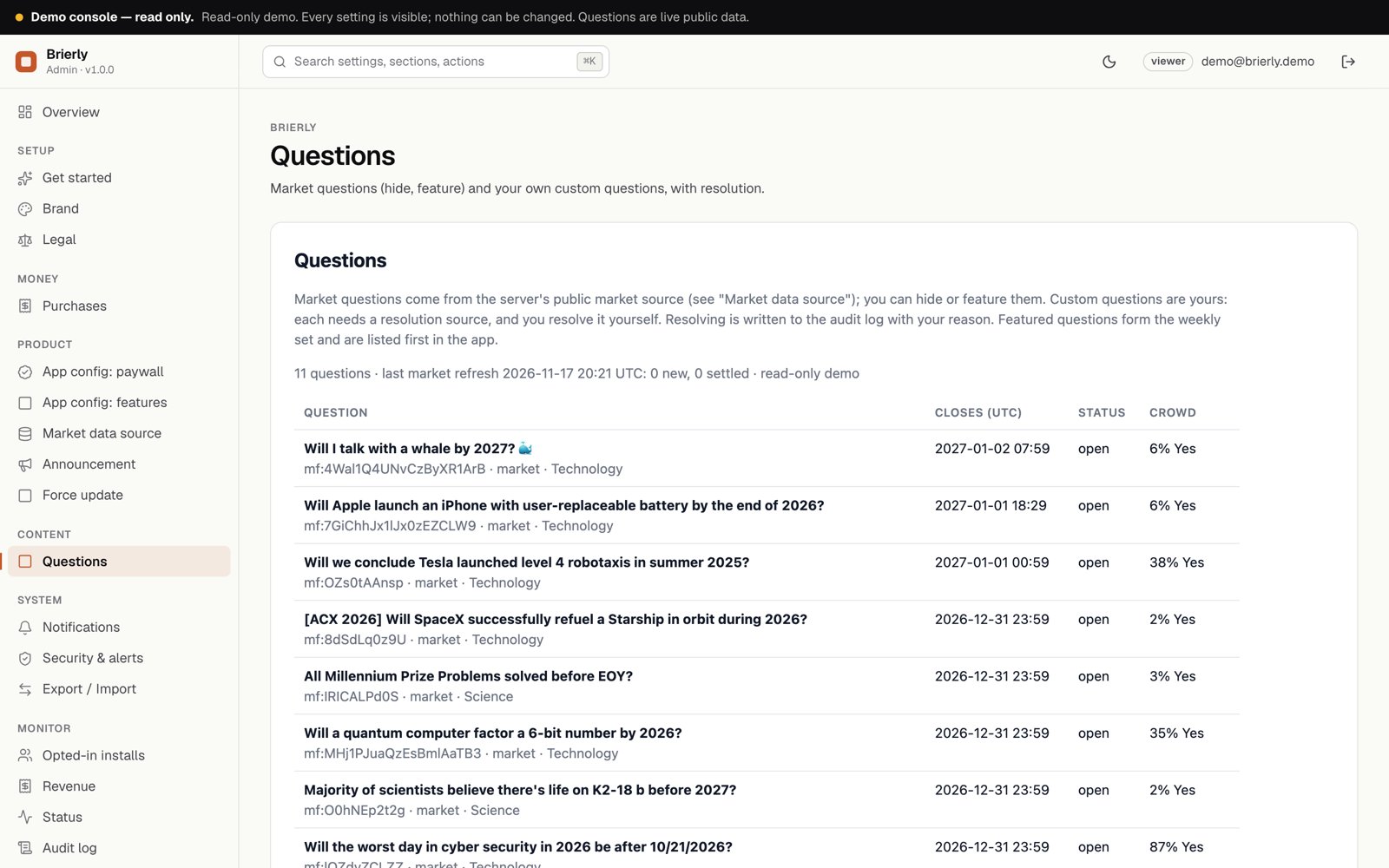
Per-question hide. Under Questions, every market question has a Hide button. A hidden question disappears from the app's list and its detail answers "not found". Check the list after each refresh, since filters cannot catch everything.
04What the server does with the data
- Only binary questions. The crowd's probability of Yes is the crowd's odds.
- The phone never calls the source. It talks only to your server. The crowd's odds exist at
GET /v1/questions/:id/crowdonly; the list and detail routes never carry them. When asked, the server refreshes a question from the source if its cache is older than 60 seconds (best effort; otherwise it answers from the cache and says when it was taken). - Private by design. Creator names, ids and avatars are never read or stored, and no link to the source's question page is sent to the app (that page would show the odds).
- Settling. After a question's close time the server checks the source and records the result. For Manifold: YES and NO become Yes and No; a cancelled question or a partial-payout result counts as void. Void questions never count in any score. A question stored from one source keeps settling from that source even if you later change the Source field.
- Category. Taken from the source's topic when it has one (shown as Economy, Science, Technology, Sports, and so on), otherwise guessed from the title, otherwise General.
Settling after a question closes was not watched live for this guide: it is covered by the server's automated tests with sample answers. Watch the first few questions you offer settle before you promote the app.
05Custom questions with audited resolution
Under Questions, Add a custom question. This works with any source setting, and is the only source if you choose None.
| Field | Rule |
|---|---|
| Question | Required, at most 200 characters, must end with a question mark. |
| Resolution criteria | Optional text, at most 2000 characters. This is what the user reads under "How it is decided". Write it so a stranger can tell Yes from No. |
| Category | At most 40 characters; General if empty. |
| Closes at (UTC) | A date and time like 2026-12-31T18:00:00Z, in the future when you create it. |
| Resolution source | Required: an https address, at most 300 characters, where the result can be checked. |
| Reference odds for Yes | Optional, from 0.01 to 0.99. If empty, the question has no crowd and the app says there is nothing to compare with; it still scores the user's Brier score. |
When the result is known, choose Yes, No or Void on that question. You must type a reason of 3 to 300 characters; it is saved in the audit log with your account and the time. Custom question ids look like c:3. Be consistent and honest: users' scores depend on your resolution.
06Weekly featured set
On the Questions page, Feature a question to put it in the weekly set. Featured questions are listed first in the app under "This week's set" and the config tells the app the Monday of the current week. Nothing is featured automatically: you choose the set, and Unfeature removes it.
07Attribution line
The app shows a data credit under market questions and in Settings, About. The server sends the line that matches the source:
- Manifold:
Data: Manifold Markets public API, not affiliated. - Polymarket Gamma:
Data: Polymarket public market data, not affiliated. - None:
Questions curated by the operator.
You can write your own line under App config: features, "Data attribution line" (at most 120 characters). Keep it true, and keep the credit the source's terms ask for. If the app has no server answer, it shows the default in app/lib/brand.dart (Data: public market data, not affiliated.). The app never links to a trading page, and Brierly is not affiliated with any data provider.